Malaysian Sea Turtle Species
 |
Malaysian Cheloniidea
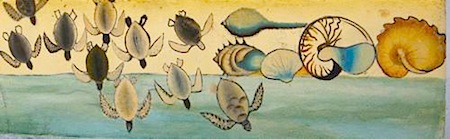
The Malaysian sea turtle species comprise mainly of the following types:
- Leatherback
- Green
- Hawksbill
- Olive Ridley
They all belong to the family called Cheloniidea, and is said to have evolved over 300 million years.
But despite their plentiful existence in earlier centuries, the world's and Malaysian sea turtles of today face severe threats, and if appropriate measures are not taken now, they may all disappear from this earth.
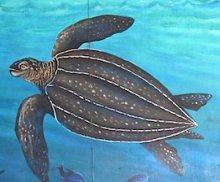
Leatherback Turtle (Dermochelys coriacea)
The Malays call them "Penyu Belimbing". And sadly, this specie is declared as critically endangered.
This is the largest of the Malaysian sea turtle species and is distinguished by its leathery-ridged carapace (shell). Mature adults can weigh up to a ton.
The principle landing and nesting site for these sea creatures in Malaysia is at Rantau Abang in the state of Terengganu.
In the 1950's when there were more than 10,000 of them landed on the beaches, visitors irresponsibly rode on them for fun. Their eggs were taken immediately after they were laid, sold and eaten as delicacies then.
Now, after a decade or more of such nonchalance actions, there are less than 10-20 landings and nestings recorded at Rantau Abang, which are signs of its extinction.
 |
Although hatchery programs were initiated since the 1960s when there were concerns on their decreasing numbers, only until the early 1990s was it known that the hundreds of thousands of hatchlings released to the sea at Rantau Abang for the last 30 years were almost exclusively females.
This was because only in the mid-1980s that scientific researches found that turtle eggs were very sensitive to heat and movement.
If the ambient temperature is above 30 degrees celcius the hatchlings are almost always female, while at temperatures below 28 degrees celcius they are sure to be males.
Unfortunately, before the research findings were made known, the eggs at the hatcheries in Terengganu were kept in open boxes to collect the warmth of the sun to hatch them.
Read more on the sea turtle sanctuaries and hatcheries in this webpage.
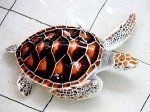
Green Turtle (Chelonia mydas)
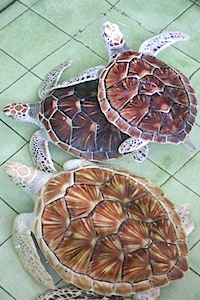
Green turtles are the most common species found in Malaysian waters. Called "Penyu Agar" in Malay, it is described as an endangered species.
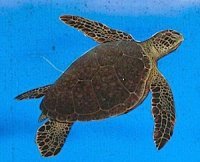 |
This specie is the second largest turtle in Malaysia. It can reach lengths of one metre and weigh to around 180 kilograms.
It is said to reach sexual maturity at between 30 and 40 years, and live to around 100 years.
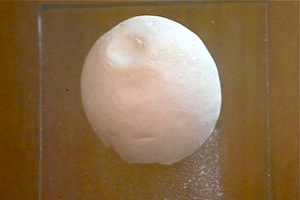 |
They feed on sea-grass and inhabit seaweed-rich coral reefs and seagrass pastures.
In Malaysia, they are found mainly at Turtle Island in Sabah, Pulau Satang in Sarawak, Pulau Redang in Terengganu, Tioman Island and Chendor Beach in Pahang.
Hawksbill Turtle (Eretmochelys imbricata)
Known as “Penyu Karah” in Malay, this specie is in the critically endangered list.
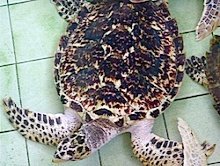 |
Hawksbills have a distinctive parrot-like beak, and feed on sponges and occasionally seagrass and soft coral.
Some concentration of this hawksbill species are found on the beaches of Melaka, and Pulau Satang in Sarawak, and the Turtle islands in Sabah.
Olive Ridley Turtle (Lepidochelys olivacea)
Called "Penyu Lipas" in Malay, this is an endangered species.
This second smallest marine turtle is named for the olive colour of its shell or carapace. Its carapace has 6 or more lateral scutes (scales) and is nearly circular and smooth.
Olive Ridleys are known to forage at depths of up to 100 meters, sometimes traveling in large groups or flotillas between their feeding and nesting grounds.
Let's Bring Back Those Years of Turtle Plenty
These four Malaysian sea turtle species have since been classified as either endangered or critically endangered and are therefore threatened with extinction.
 |
We hope the current generation of Malaysians will do its utmost to ensure that those wonderful years of turtle aplenty will be seen again on the beaches of Malaysia that once were their homes and birthplace.
Know that ensuring the survival and resuscitation of these Malaysian marine creatures is not just for their sake but ours too, because our pride as humans is at stake.
We CAN do it.
Smile.

|
Return here from Malaysian Sea Turtle Species to Malaysian Sea Turtles page.
Return here from Malaysian Sea Turtle Species to Malaysia Wildlife and Nature homepage.


Visit Our Visitors Favorite Pages
 |
 |
 |
 |
 |
 |
 |
|
|


And among His Signs is the creation of the heavens and the earth, and the living creatures that He has scattered through them: and He has Power to gather them together when He wills. There is not an animal (that lives) on the earth, nor a being that flies on its wings, but (forms part of) communities like you. And God has created every animal from water: of them there are some that creep on their bellies; some that walk on two legs; and some that walk on four. God creates what He wills for verily God has power over all things.
|
Get their best prices HERE!
|